
Behavioral Therapy
DBT, or dialectical behavior therapy, is well known around the world as a powerful way to deal with emotional pain, make friends, and improve mental health. Group therapy is a popular way to do DBT, though most people do it one-on-one. It has its own pros and cons. It will talk about the issues that might come up with group therapy, how dialectical behavior therapy works, and how well it helps with many different mental health issues in general.
What Are the Cons of DBT Group Therapy?
DBT group therapy aims at helping people learn skills in dealing with stress, regulating their emotions, and dealing with people. But, like any other healing method, it could have some problems:
Privacy Concerns: They are not willing to share examples with a group of people. Newcomers to behavioral therapy do not like talking to other people because this brings fear of being judged or seen in a bad light.
Difficulty Keeping Up: Should people attend the DBT group therapy meetings, such meetings will usually have been organized in advance. If a participant misses a lesson, or fails to grasp some of the materials taught in the lesson, it can be a challenge to recover that lost ground. This may well reduce their ability to benefit from the therapy optimally.
Diverse Group Dynamics: People in groups often have different levels of knowledge and dedication to the process. When people aren’t engaged or making progress at the same rate, it can be frustrating, especially if they think the group is going too quickly or too slowly.
Limited Personalization: Group treatment, unlike dialectical behavior therapy for one person, can’t change the way they talk or do things to fit the needs of just one person. This could be a problem for people who need more individualized help.
Potential for Triggers: Hearing other people talk about their problems can sometimes make people feel things, especially if they are dealing with trauma or serious emotional distress.
Nevertheless, such problems do exist but DBT group therapy is really beneficial to many who need it, especially, when it’s performed together with individual DBT or as one of the segments of the general program of treatment.
How Does Dialectical Behavior Therapy (DBT) Work?
DBT was originally created by Dr. Marsha Linehan to be applied to persons having BPD, Borderline Personality Disorder. The first person to use it was her. It has been utilized for more mental illnesses over time such as; anxiety, depression, eating disorders and drug use disorders.
Key Components of DBT
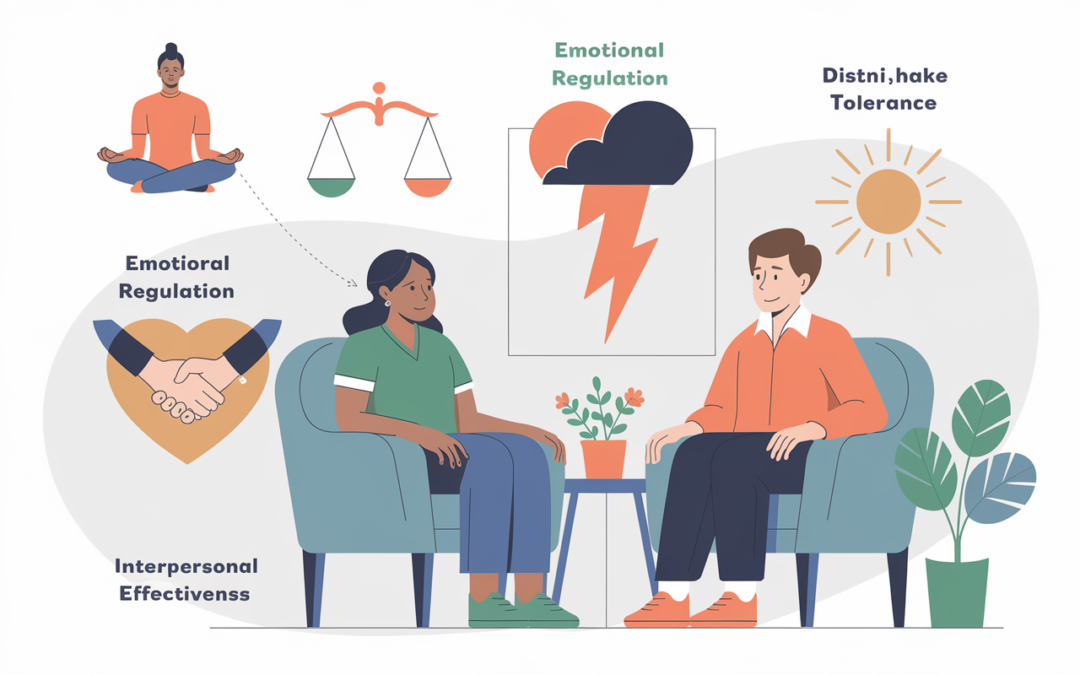
From DBT, you should be able, in some way, to both accept things and to promote change. Mindfulness-based and cognitive-behavioral techniques are used, and it is taught in four major modules:
Mindfulness: Dialectical behavior treatment includes use of principles of mindfulness. Individuals are taught ways of being in the present moment while avoiding the judgments. When someone learns this skill, they become more aware of their thoughts and feelings, which helps them answer more carefully instead of quickly.
Distress Tolerance: People who take this module will learn how to deal with strong feelings and crises without acting in harmful ways. People are often taught techniques like extreme acceptance, self-soothing, and distraction.
Emotional Regulation: People who take this module learn how to recognize, understand, and control their feelings. This means making people less emotionally vulnerable and giving them more good emotional experiences.
Interpersonal Effectiveness: In this lesson, you will gain knowledge on how best to communicate or approach people and establish rapport with the right manner. This way, the other teaches people how to say no and state their boundaries, ask for what they want, and handle conflicts in relationships.
Delivery Formats of DBT: There are two main ways that dialectical behavior treatment is usually given:
- Individual Therapy: Individual therapy is when you meet with a therapist alone to work through specific problems and use DBT skills.
- DBT Group Therapy: When people go to DBT group therapy classes, they learn and practice skills with others in a safe space.
Phone coaching is often available for real-time help and guidance in both formats.
Is Dialectical Behavior Therapy Effective?
A lot of study and writing has been done on how well dialectical behavior therapy works. Many people with mental health issues believe it to be one of the best ways to get better.
Conditions Treated with DBT
Borderline Personality Disorder (BPD): DBT was initially developed specifically for people like those with BPD and it remains the gold standard. Research conducted on the same reveals that a great deal of reduction in self-harm, suicidal intentions and mental instability.
Depression and Anxiety: Self Managing Antidepressant SSRI and DBT behavior therapy for sadness and anxiety have been revealed to support patients dealing with their conditions through adopting appropriate strategies of behavior.
Substance Use Disorders: In DBT targeting distress tolerance and mindfulness has been of benefit to people suffering from addiction especially because they have been able to reduce the level of vulnerability of relapse and have enhanced the individuals’ emotional resilience.
Eating Disorders: DBT is for individuals with eating issues like bulimia and binge eating by coaching them on improved approaches to manage stress and emotional factors.
Evidence Supporting DBT’s Effectiveness: Research shows over and over again that dialectical behavior treatment is helpful:
- I found an article in the American Journal of Psychiatry that reported DBT effective in retaining individuals with BPD in treatment and reported fewer suicidal ideas and acts.
- A systematic review that got published in the journal Cognitive Behavioral Therapy in 2020 showed that individuals who had mood difficulties had better ways of managing their feelings with the help of DBT.
Why DBT Works
Dialectical behavior treatment works because it looks at the whole person. It gives people useful tools to handle their feelings and encourages self-compassion by talking about both acceptance and change. The group treatment part makes people feel like they are part of a community and helps them learn from each other, which makes it even more effective.
Final Thoughts
Due to its structured style and group dynamics, DBT group therapy may not be right for everyone. However, for many, it is still a very helpful tool. When done hand in hand with individual therapy, it provides a system of handling emotional issues besides improving overall wellbeing.
DBT has been found useful in treating individuals with emotion regulation, interpersonal relationship or other mental disorder issues. DBT aims to provide those who struggle with the necessary skills to deal with life by well-explained concepts like mindfulness, emotional regulation and interpersonal effectiveness.
If you’re considering therapy to boost your mental health, DBT could be a huge step toward a better live. This is true whether you do it alone or in a group.
Behavioral Therapy
Behavior therapy is now a key part of mental health treatment. It helps almost all psychological issues using an evidence-based approach. The most widely used treatment described above is DBT treatment and CBT. While many of them share certain similarities, they remain very distinct in what they focus on and how they are applied. But what is dialectical behavior therapy? How does it relate to cognitive behavioral therapy? What techniques set DBT apart?
What is DBT Therapy?
It is known as dialectical behavior therapy and was introduced in the late 1980s by Dr. Marsha Linehan. This treatment was first for borderline personality disorder. It has since been used for other mental health issues, such as depression, anxiety, and eating and substance use disorders.
The word ‘dialectical’ defines the balance between two opposites: acceptance versus change. DBT stresses understanding and validating one’s emotions. It also supports growth and change.For this reason, this two-pronged approach makes DBT treatment very helpful for those who are having strong difficulties with emotions, self-destructive behaviors, or relationships.
Core Components of DBT Therapy
DBT therapy typically consists of four main components:
Individual Therapy: Clients, supervised by a therapist, work to tackle personal challenges. They set goals and learn coping strategies. Group Skills Training
Group Skills Training: Group sessions teach useful skills in four areas: controlling emotions, being aware, dealing with stress, and getting along with others.
Phone Coaching: Support is provided after sessions. It is for clients to work through DBT skills in real time ‘in the moment’.
Therapist Consultation Teams: Consultation groups are held so therapists can work together. The goal is to provide effective, kind care.
What Are the Differences Between CBT and DBT?
CBT and DBT are two evidence-based, behavioral techniques. Each focuses on a patient’s needs in a different way and has a different application. Here are some key differences in detail:
Focus
- Cognitive Behavioral Therapy (CBT): The CBT pursues negative thinking patterns, which yield negative feelings and behaviors. The treatment itself is goal-oriented and teaches the patient how to do things which just work in opposition to such cognitive distortions, catastrophizing, or Black and White thinking.
- Dialectical Behavior Therapy (DBT): It’s the same as DBT therapy because it addresses it. But, it is not the same. It manages emotions and builds social skills. DBD uses a dialectical approach. It balances acceptance of a person’s experience with a need for change.
Techniques
CBT:
- Cognitive restructuring
- Behavioral activation
- Problem-solving
- Exposure therapy
DBT:
- Mindfulness exercises
- Emotional regulation techniques
- Distress tolerance strategies
- Skills of interpersonal effectiveness
Target Population
CBT: Anxiety, depression, phobia, and PTSD are common conditions that it currently treats.
DBT: Dialectical behavior therapy helps patients with:
- extreme emotional dysregulation,
- chronic self-injury, or
- borderline personality or eating disorders.
Approach to Emotions
CBT: Makes an effort to change the thought behind the emotion.
DBT: It teaches people to feel their emotions, without judgment or avoidance, and to let them go.
Knowing these differences can assist individuals and therapists deciding an approach that suits them.
What Are Dialectical Behavior Therapy Techniques?
The practical techniques in dialectical behavior therapy are a strong point of this approach. They improve emotional and social skills. Here are the four main skill areas taught in DBT:
Mindfulness
DBT therapy is founded on mindfulness. It means being fully present and accepting, without judgment, whatever is happening in your body. This includes your mind, emotions, and physical state. Mindfulness helps clients to see and respond, not react.
Example Techniques:
- Counting your way through FOMO’s meaning.
- Focusing on your breath when you’re engaged in grounding exercises.
Emotional Regulation
Skills in emotional regulation help with how to manage intense emotions that can feel like too much to bear or do anything about. These techniques aim at knowing about emotion, not being vulnerable to negative emotion, and generating positive experience.
Example Techniques:
- That is, labeling emotions.
- A self care routine to create emotional vulnerability.
- The use of opposite action (e.g., smiling while feeling sad).
Distress Tolerance
Distress tolerance skills are abilities for a person to stay afloat when in the middle of turmoil and avoid using substances and self destructing behavior. They focus on learning healthy ways to bear what could be distressful.
Example Techniques:
- We use the TIPP method of Temperature, Intense exercise, Paced breathing, Progressive relaxation.
- This means practicing radical acceptance, the idea of trying to willfully accept situations that you can’t change.
Interpersonal Effectiveness
Skills that help clients overcome interpersonal difficulty include teaching clients assertiveness, active listening and boundary setting. They are particularly useful to improve communication as well as conflict resolution.
Example Techniques:
- In other words, DEAR MAN (Describe, Express, Assert, Reinforce, Mindful, Appear confident, Negotiate).
- The FAST motto is Fair, Apologies avoided, Stick to values, and Truthful.
And by mastering these techniques, learning how to better handle emotion and evolving relationships, clients can achieve better emotional balance.
What Type of Therapy is Behavioral Therapy?
Behavioral therapy is a collective term for those therapeutic approaches which emphasize the alteration of harmful behaviors. It contains the belief that by learning something is learned, and can be unlearned or substituted with healthier alternative.
Key Characteristics of Behavioral Therapy
Action-Oriented: It focuses on what you can do to change particular behaviors, not what lead you to those behaviors in the past.
Goal-Oriented: Clients and therapists sit down together to establish measurable, realistic goals.
Evidence-Based: As we know, behavioral therapy bases its techniques on science.
Short-Term: Structured, on a short term time basis.
Types of Behavioral Therapy
CBT (Cognitive Behavioral Therapy): According to the fact, comprehensive treatment involves behavioral techniques along with cognitive intervention to deal with thought and behavioral patterns.
DBT (Dialectical Behavior Therapy): A behavioral therapy subset, it combines acceptance and change of emotional and interpersonal challenges.
Exposure Therapy: This therapy is used for anxiety disorders and involves making someone who is anxious very slowly uncover his fear.
Behavioral Activation: It is often used for depression because it encourages clients to do positive activities to help improve mood and lower avoidance.
Accompanied by versatility and effectiveness, behavioral therapy is a cornerstone of mental health treatment for conditions.
Conclusion
There are powerful tools with behavioral therapy to assist people in navigating with emotional and mental obstacles. CBT and DBT are among its methods of treatment that are effective and flexible. Unlike CBT, DBT focuses on balancing acceptance and change, or what accepting and changing something might look like, – and that makes it an especially helpful tool for emotional regulation and interpersonal challenges.
So they could begin to understand how dialectical behavior therapy—skills including mindfulness, distress tolerance and emotional regulation—form a toolbox of skills to help themselves cope with life’s challenges. These evidence based strategies if you’re wondering what behavioral therapy for you or someone you love is all about really lay a solid foundation to improving your mental health and wellbeing, hands down.